
Considering veneers in Dubai? Discover the differences between porcelain and composite veneers, typical 2026 costs, treatment steps, preparation, longevity, natural smile design, and how to choose the right cosmetic dentist.

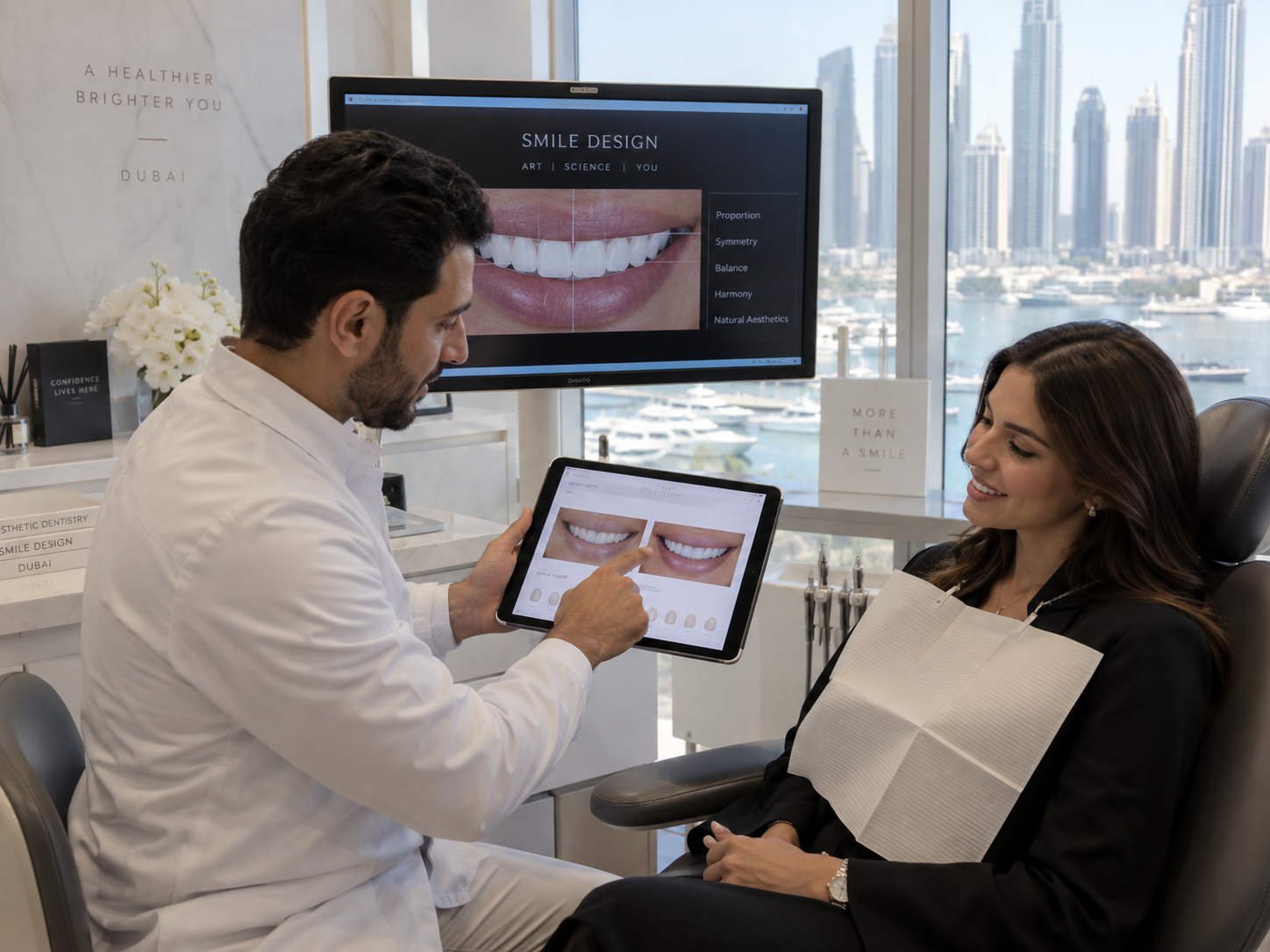
If you are considering veneers Dubai, the most important decision is not simply choosing the whitest shade or the lowest price. A successful veneer treatment should consider your natural teeth, facial proportions, lips, gums, bite, smile line, and long term oral health.
Dental veneers are thin coverings placed over the visible surface of teeth to improve concerns such as staining, chips, uneven shapes, small gaps, and certain minor alignment issues. Porcelain and composite resin are the two main options, and each has different advantages.
The right treatment depends on your smile, your dental health, your expectations, and how much tooth preparation the treatment requires. A careful consultation should always come before deciding how many veneers you need or which material is right for you.
At Dr. Zeinab Taie’s Dubai Marina practice, the focus is on personalised and natural looking smile design. Dr. Taie is a British trained dentist with more than 20 years of experience, an LDS qualification from the Royal College of Surgeons of England, and a Master’s degree in Oral Pathology from Queen Mary University of London.
What Are Dental Veneers?
Dental veneers are thin, custom made coverings designed to improve the visible appearance of teeth. They can change the colour, shape, proportion, and appearance of individual teeth while creating a more balanced overall smile.
According to the American Dental Association, veneers can improve the appearance of chipped, broken, stained, crooked, or misshapen teeth and can also help mask gaps between teeth. The ADA also explains that veneers differ from crowns because they cover the front surface rather than the entire tooth. [Source: American Dental Association]
This makes veneers particularly popular among patients who want a significant aesthetic improvement without placing full crowns on otherwise suitable teeth.
However, veneers are not simply cosmetic stickers placed over teeth.
The dentist must first determine whether your teeth and gums are healthy enough for treatment. Existing decay, gum disease, bite problems, heavy grinding, or other concerns may need attention before cosmetic treatment begins.
That is why a proper consultation should always come before choosing a veneer material or deciding how many teeth to treat.
Why Are Veneers So Popular in Dubai?
Dubai has become a major destination for cosmetic dentistry, with patients seeking treatments that improve both their appearance and confidence.
A smile can influence how people feel in photographs, professional situations, social settings, and everyday conversations. For some patients, veneers offer a way to address several aesthetic concerns at the same time.
One patient may want to improve severe staining that does not respond well to whitening.
Another may want to soften the appearance of chipped or worn teeth.
Someone else may have small spaces between their teeth and want a more symmetrical smile.
Veneers can sometimes address several of these concerns within one carefully planned treatment.
However, the popularity of veneers also means patients need to look beyond dramatic before and after photographs.
The best veneer result is not necessarily the brightest or most uniform smile.
It is the smile that looks believable, balanced, healthy, and appropriate for the individual.
Who Can Benefit From Veneers?
Veneers may be suitable for patients who have healthy teeth and gums but feel unhappy with particular aesthetic features of their smile.
Common concerns include persistent tooth discolouration, small chips, uneven tooth edges, minor gaps, irregular tooth shapes, worn teeth, and certain minor alignment concerns.
The key word is suitable.
Not every cosmetic concern requires veneers.
For example, a patient with relatively healthy teeth that only appear slightly yellow may achieve the desired improvement through professional whitening. Someone with significant tooth crowding may benefit more from orthodontic treatment such as Invisalign before considering cosmetic restorations.
A responsible cosmetic dentist should therefore look at the whole smile rather than automatically recommending veneers.
At Dr. Zeinab Taie’s practice, treatment planning focuses on creating a smile that works with the patient’s facial features rather than applying the same design to every person.
The practice describes its approach as natural smile design tailored to factors including the face, lips, and skin tone.
Porcelain vs Resin Veneers
One of the most important decisions when considering veneers Dubai is choosing between porcelain and composite resin.
Porcelain Veneers
Porcelain veneers are custom made thin ceramic restorations that are bonded to the front of the teeth.
They are known for their natural appearance, durability, and resistance to staining. The ADA describes porcelain veneers as strong, long lasting, and natural looking.
They are often selected by patients seeking a more comprehensive smile transformation or a highly refined aesthetic result.
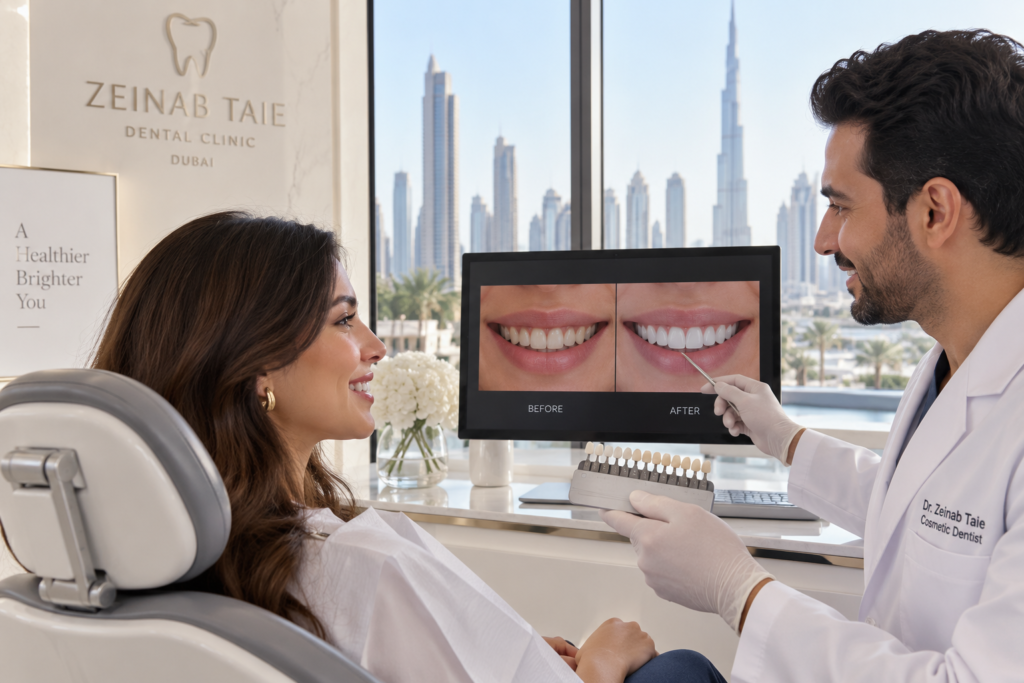
At Dr. Zeinab Taie’s Dubai Marina practice, porcelain veneers are custom planned around the patient’s desired shape, colour, proportions, and smile design.
However, porcelain veneers usually require more planning and laboratory work than direct composite veneers. Tooth preparation may also be required depending on the case.
Resin or Composite Veneers
Composite veneers use tooth coloured resin that the dentist applies, shapes, and polishes directly on the teeth.
They can be a useful option for patients who want a more affordable or conservative cosmetic improvement. Treatment can often take fewer visits, and damaged composite can usually be repaired more easily than a damaged porcelain restoration.
The trade off is that composite resin generally does not have the same stain resistance or long term durability as porcelain.
The American Dental Association notes that composite veneers may require less enamel removal and fewer visits, while porcelain generally offers stronger and more stain resistant results. [Source: American Dental Association]
The best material is therefore not automatically the most expensive one.
It should be the material that makes clinical and aesthetic sense for your particular smile.
How Much Do Veneers Cost in Dubai?
Cost is one of the first questions patients ask when researching veneers Dubai.
There is no single fixed price because the total investment depends on several factors, including the material, number of teeth, complexity of the case, dentist’s experience, laboratory, preparation required, and level of customisation.
Current 2026 Dubai market guides show broad ranges rather than one standard price. Composite veneers commonly appear around AED 700 to AED 1,500 per tooth, while porcelain and E max options commonly fall around AED 1,500 to AED 3,500 or more depending on the clinic and case. Some premium practices quote considerably higher prices for highly customised ceramic work.
These figures should be treated as market guidance rather than a quotation from a specific dentist.
The cheapest advertised veneer is not necessarily the best value.
When comparing quotes, ask whether the price includes the consultation, diagnostic records, smile planning, temporary restorations, laboratory work, final bonding, and follow up care.
Most importantly, compare like with like.
A premium porcelain veneer made by an experienced cosmetic dentist with a highly skilled laboratory should not be compared directly with an entry level promotional composite veneer.
Your written treatment plan should make those differences clear.
How Many Veneers Do You Actually Need?
This is one of the most misunderstood parts of cosmetic dentistry.
There is no universal number.
Some patients need only one veneer because they want to restore a damaged front tooth. Others may benefit from four, six, eight, or ten veneers depending on their smile line, tooth proportions, facial features, and desired result.
The number should come from the smile design rather than from a package.
If only the upper front teeth show when you smile, treating every visible tooth may not be necessary. In some cases, whitening or another conservative treatment can help the untreated teeth blend with the new restorations.
A good cosmetic dentist should therefore assess your smile both when your lips are relaxed and when you smile naturally.
This helps determine how many teeth actually influence the appearance of your smile.
What Happens During Veneer Treatment?
The veneer journey usually begins with a detailed consultation.
Your dentist examines your teeth and gums, discusses your concerns, evaluates your bite, and determines whether veneers are appropriate.
The next stage involves smile planning.
Your desired tooth shape, colour, proportions, and overall aesthetic direction can be discussed before the final restorations are produced.
For porcelain veneers, the dentist generally prepares the teeth as clinically appropriate, records the required information, and works with a dental laboratory to create the custom restorations. The veneers are then assessed for fit, shape, colour, and appearance before final bonding.
The ADA describes a similar process involving tooth preparation, impressions or digital scanning, laboratory fabrication, checking the fit, and final bonding. [Source: American Dental Association]
Composite veneers follow a different process because the resin can be directly applied and sculpted onto the tooth.
This may allow treatment to take place in fewer visits.
Regardless of the material, the final stage should include careful attention to bite, comfort, shape, shade, and overall smile balance.
Do Veneers Require Tooth Preparation?
This question deserves a careful answer because the amount of preparation varies between patients and veneer designs.
Traditional porcelain veneers generally involve removing a small amount of enamel to create space for the restoration. The exact amount depends on the tooth, the desired change, the existing position of the tooth, and the planned restoration.
The American Dental Association explains that porcelain veneer placement involves removing a small amount of enamel from the front and sides of the tooth. It also emphasises that veneer treatment is not reversible. [Source: American Dental Association]
Some patients may be suitable for more conservative or minimal preparation approaches.
However, terms such as “no prep” should never be interpreted as meaning that every patient can receive veneers without altering the tooth.
Your dentist needs to assess your individual anatomy and smile goals first.
At Dr. Zeinab Taie’s practice, the stated philosophy focuses on conservative treatment and natural looking results where clinically suitable.
That is an important distinction.
Good cosmetic dentistry is not about removing as much tooth structure as possible.
It is about achieving the desired result while respecting healthy natural tooth structure.
Can Veneers Look Completely Natural?
Yes, when they are carefully designed and properly executed.
Natural looking veneers depend on more than simply choosing a natural tooth colour.
The shape of the teeth, surface texture, translucency, proportions, contact points, gum relationship, smile line, and relationship with the surrounding facial features all influence the final appearance.
This is why two patients can receive the same material and still achieve completely different looking results.
At Dr. Zeinab Taie’s practice, natural smile design is a central part of the treatment philosophy. The clinic describes its veneers as being designed around the patient’s face, lips, and skin tone rather than creating a standardised smile.
That approach matters because your smile should look like yours.
A beautifully designed veneer should attract attention to your overall appearance rather than making people immediately notice that you have had dental work.
How Long Do Veneers Last?
Veneer longevity depends on the material, quality of treatment, bite, oral hygiene, lifestyle, and how well the restorations are maintained.
Porcelain veneers can often provide many years of service when properly planned and cared for. Current Dubai dental guides commonly estimate around 10 to 15 years for porcelain veneers, although individual results vary.
Composite veneers generally have a shorter expected lifespan and may require maintenance, polishing, repair, or replacement sooner.
The ADA also notes that veneers can chip, crack, wear down, or loosen over time and may need repair or replacement.
This is why veneers should never be viewed as a completely maintenance free cosmetic treatment.
Regular dental examinations remain important.
You should also avoid using your teeth to open packaging, biting very hard objects, or ignoring signs of grinding or clenching.
What Can Damage or Shorten the Life of Veneers?
Your daily habits can have a significant effect on your restorations.
Heavy grinding and clenching can place excessive forces on veneers. Biting hard objects can also cause damage.
Poor oral hygiene creates another problem because the natural tooth underneath and around a veneer can still develop decay.
The ADA recommends maintaining normal dental hygiene, including brushing twice daily with fluoride toothpaste and cleaning between the teeth every day.
If you grind your teeth, your dentist may also discuss protective measures such as a night guard.
Veneers improve the appearance of teeth, but they do not make the teeth indestructible.
Good aftercare protects both your investment and your natural oral health.
Veneers vs Whitening vs Invisalign
Sometimes veneers are not the first treatment you should choose.
If your teeth are healthy and your main concern is colour, professional teeth whitening may be enough.
If your main concern is tooth position, Invisalign may provide a more appropriate long term solution.
If you have small chips or minor shape irregularities, composite bonding or resin veneers may provide a conservative alternative.
If several aesthetic concerns occur together, a comprehensive smile makeover may combine different treatments rather than relying entirely on veneers.
This is why a personalised assessment matters.
The question should not be “Which treatment can change my smile the fastest?”
A better question is “Which treatment can achieve my desired result while protecting my oral health and natural teeth?”
How to Choose a Dentist for Veneers in Dubai
Choosing a dentist for cosmetic dentistry requires more than looking at an attractive clinic or a social media photograph.
Start with qualifications and clinical experience.
Then look at the dentist’s actual approach to cosmetic dentistry.
Do the results look natural?
Do different patients receive different smile designs?
Does the dentist discuss alternatives?
Does the consultation include your bite, gums, existing teeth, and long term oral health?
A trustworthy dentist should also explain limitations.
The American Dental Association recommends that patients discuss their dental history, expectations, and concerns with a licensed dentist before deciding whether veneers are appropriate.
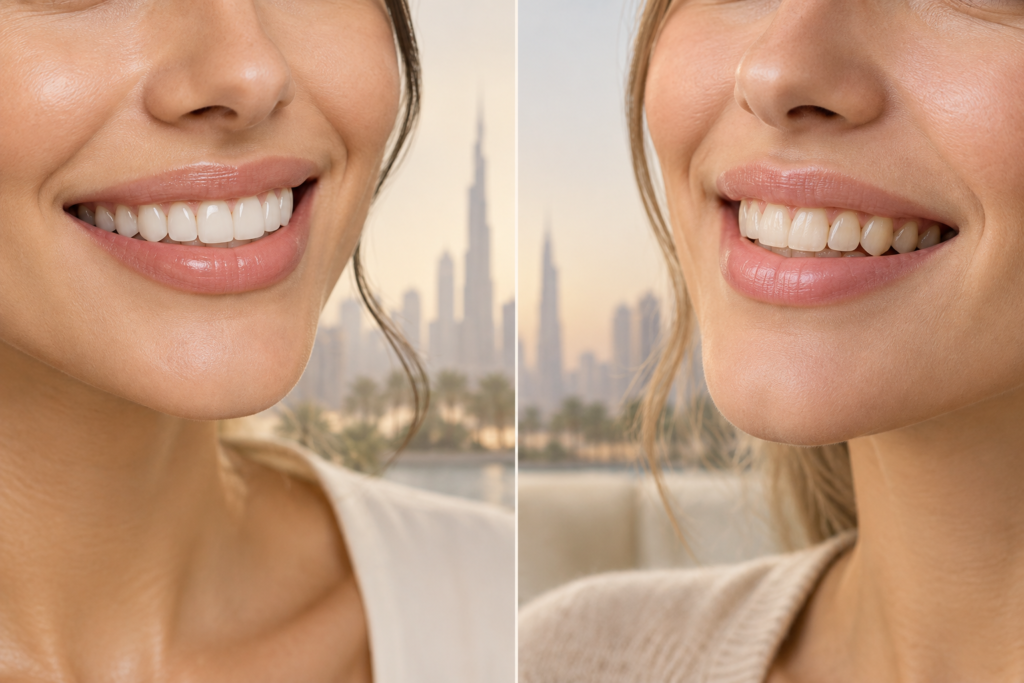
For patients considering veneers in Dubai Marina, Dr. Zeinab Taie’s practice provides both porcelain and resin veneer treatments. The clinic also showcases veneer transformations through its smile gallery and describes its approach as personalised, natural looking, and minimally invasive where appropriate.
Why Natural Smile Design Matters
There was a time when cosmetic dentistry was often associated with extremely white, extremely uniform teeth.
Today, many patients want something different.
They want a smile that looks polished but still believable.
That requires a more individual approach.
The ideal shade may not be the whitest shade. The ideal tooth shape may not be perfectly square. The ideal number of veneers may not be ten.
Your smile should be designed around your face rather than around a trend.
This is particularly important for patients who want cosmetic dentistry that remains attractive several years from now.
Trends change.
Natural proportions remain timeless.
Frequently Asked Questions About Veneers Dubai
How much do veneers cost in Dubai?
The cost varies according to material, number of teeth, dentist, laboratory, complexity, and level of customisation. Current 2026 market guides commonly place composite veneers around AED 700 to AED 1,500 per tooth and porcelain or E max veneers around AED 1,500 to AED 3,500 or more, although premium treatments can cost considerably more.
Are veneers permanent?
Veneers can provide long term results, but they are not permanent for life. Porcelain may last many years with appropriate care, while composite generally requires maintenance sooner. Conventional porcelain veneer treatment is also considered irreversible because enamel preparation may be involved.
Do veneers damage natural teeth?
Veneers themselves do not automatically damage healthy teeth when appropriately planned and placed by a qualified dentist. However, conventional porcelain veneer treatment may require removal of some enamel, which is why careful diagnosis and conservative planning are important.
Are porcelain veneers better than composite veneers?
Neither material is universally better. Porcelain generally offers excellent aesthetics, durability, and stain resistance, while composite can be more affordable, faster to place, and easier to repair. Your dentist should recommend the material based on your individual needs.
How many veneers do I need?
It depends on your smile and the changes you want to make. Some patients may need one veneer, while others may benefit from several veneers across the visible smile zone. The correct number should come from an individual smile assessment rather than a standard package.
Can veneers fix crooked teeth?
Veneers can sometimes improve the appearance of minor alignment irregularities. However, they do not replace orthodontic treatment for significant tooth movement. Invisalign or another orthodontic option may be more appropriate when the underlying position of the teeth needs correction.
Can I get veneers if I have gum disease?
Existing dental problems should be treated before veneers are placed. The ADA specifically advises that conditions such as decay or gum disease should be addressed before veneer treatment.
Do veneers stain?
Porcelain is highly resistant to staining, while composite resin can be more susceptible to discolouration over time. Your diet, oral hygiene, smoking habits, and maintenance can also influence the appearance of your restorations.
Final Thoughts
Choosing veneers Dubai should never begin with a price tag or a photograph of someone else’s smile.
It should begin with your teeth.
Your dentist should understand your oral health, your bite, your facial proportions, your smile goals, and the amount of treatment you actually need.
From there, the right material, number of veneers, shade, shape, preparation, and treatment sequence can be decided.
Porcelain may be ideal for one patient. Composite may make more sense for another. Someone else may achieve a better result with whitening or Invisalign before considering veneers.
That is what personalised cosmetic dentistry should look like.
At Dr. Zeinab Taie’s practice in Dubai Marina, veneer treatment is built around natural smile design, personalised planning, and careful attention to aesthetics and function. The practice offers both porcelain and resin veneers and focuses on creating smiles that feel individual rather than artificial.
If you are considering veneers, the best next step is not choosing a package.
It is booking a consultation.
Ready to Explore Your Veneer Options?
Your smile does not need to look like anyone else’s.
If you are considering veneers in Dubai, Dr. Zeinab Taie can assess your smile, discuss your concerns, explain the available options, and help you understand which approach may be appropriate for your teeth.
Dr. Zeinab Taie
Natural Smile Expert and General Dentist
Dubai Marina, Dubai
WhatsApp: +971 58 596 0580
Email: Taie.zeinab@gmail.com
Book a consultation and discover what a personalised, natural looking smile could look like for you.