
Porcelain or composite veneers? Dubai’s Dr. Zeinab Taie compares cost, durability & natural results to help you choose the right smile makeover.

If you have spent any time searching for a smile makeover in Dubai, you already know the feeling. Every clinic claims to have the best veneers. Every Instagram page shows a dazzling before-and-after. And somewhere in the middle of all that noise sits one genuinely important question: porcelain or composite?
It is the single most common question I get asked at my clinic in Salman Bin Abdulaziz – King Salman Bin Abdulaziz Al Saud St – Marsa Dubai – Dubai Marina – Dubai – United Arab Emirates, and it deserves a real answer, not a sales pitch.

Dr. Zeinab Taie has spent two decades helping patients in Dubai choose the right veneer material for their smile.
My approach to this question has not changed in over twenty years of practice: I do not sell smiles. I restore confidence. That means giving you the honest clinical picture, not just the version that sounds best in a marketing brochure. So in this guide, we will walk through exactly what separates porcelain from composite veneers, what each one actually costs you over time, and how to think about the decision in a way that protects both your smile and your natural teeth.
What Is a Dental Veneer, Exactly?
Before comparing materials, it is worth clearing up a common point of confusion. A veneer is not the same thing as a crown, and mixing the two up can lead patients to expect (or fear) the wrong procedure entirely.
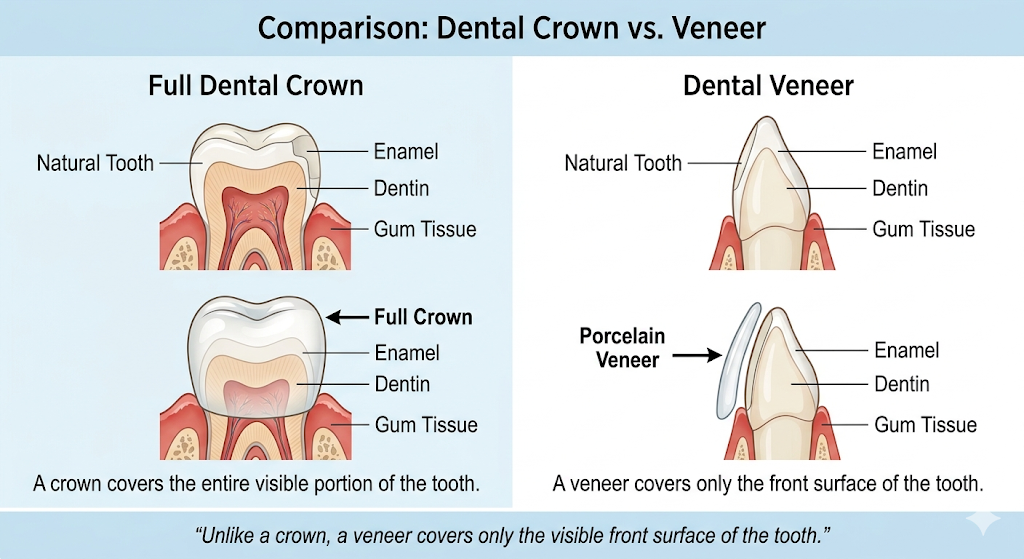
Unlike a crown, a veneer covers only the visible front surface of the tooth.
Think of a veneer as a thin, custom-made shell, similar in concept to a contact lens. A contact lens rests gently on the front of your eye to correct your vision. A veneer rests on the front of your tooth to correct its shape, color, or alignment. A crown, by contrast, requires the entire tooth to be filed down into a small peg, which is a much more invasive procedure typically reserved for teeth that are severely damaged or decayed.
Because a true veneer only touches the front surface, it is considered a conservative cosmetic treatment, especially when placed by a dentist who is committed to preserving as much of your natural enamel as possible.
Composite Veneers: Fast, Affordable, and Artist-Dependent
Composite veneers have surged in popularity over the past few years, largely thanks to social media trends showcasing same-day transformations. The material itself is a tooth-colored resin, the same substance used in modern white fillings, applied directly onto your teeth and sculpted by hand.
How the Procedure Works
Unlike porcelain, composite requires no dental laboratory. You sit in the chair, I apply the soft resin directly onto your teeth, sculpt it freehand to match natural tooth contours, harden it instantly with a curing light, and polish it to a natural shine. Start to finish, it is usually a single appointment.
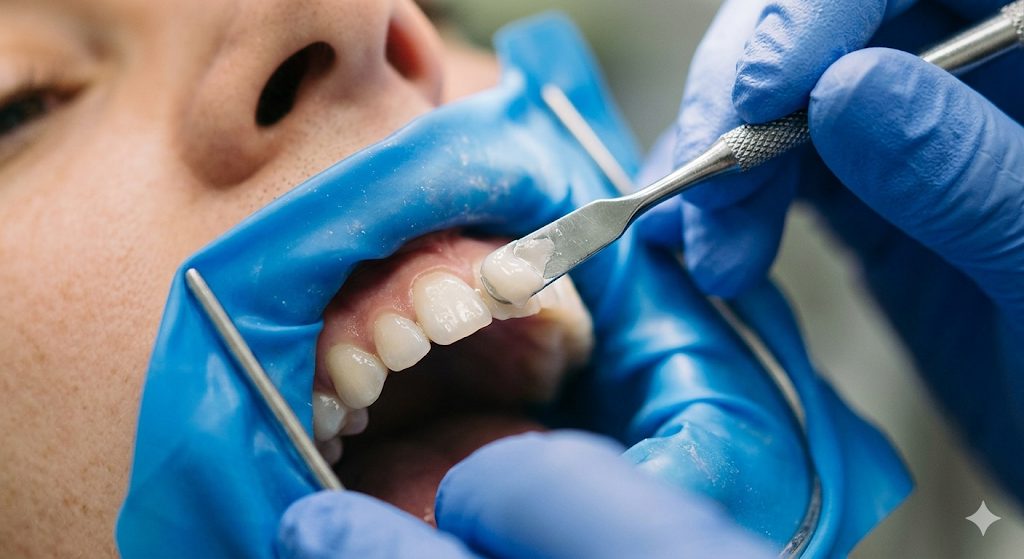
Composite veneers are shaped freehand, chairside, in a single visit.
Composite Veneers: Pros and Cons
Advantages
- Same-day results. No laboratory wait. You walk in with your current smile and leave with a new one.
- Minimal to no enamel removal, since the resin bonds directly onto the existing tooth surface.
- Lower upfront cost, since there are no laboratory fees involved.
- Easy, fast repairs. A chip can usually be fixed by adding more resin in a short appointment.
Disadvantages
- Stains over time. Composite resin is slightly porous, so coffee, tea, red wine, and smoking will gradually dull its shine, especially given Dubai’s coffee and dining culture.
- Shorter lifespan. With excellent care, composite typically lasts five to seven years before it needs replacing.
- Less optical depth. A skilled dentist can make composite look beautiful, but resin cannot fully replicate the way light travels through natural enamel the way porcelain can.
Composite is an excellent choice for patients who want a conservative, budget-friendly way to correct minor chips, gaps, or discoloration, or who want to “test drive” a new smile shape before committing to something permanent.
Porcelain Veneers: The Long-Term Standard
When patients ask how public figures achieve smiles that look flawless yet completely natural, the answer is almost always high-quality dental porcelain. Modern porcelain veneers are typically crafted from lithium disilicate (commonly known as e.max), an advanced ceramic that combines strength with remarkable translucency.
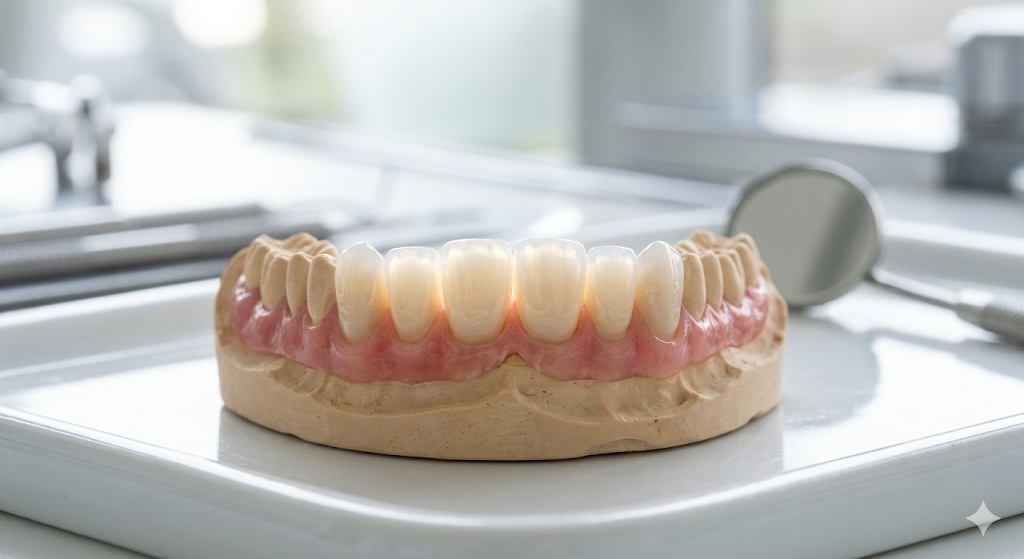
High-grade porcelain like e.max mimics how light travels through natural enamel.
How the Procedure Works
Porcelain is an indirect treatment, meaning it is fabricated outside your mouth. The process generally spans two to three weeks across a few appointments: a digital smile design session, precise 3D scans sent to a master ceramist, hand-layered fabrication in a dental laboratory, and a final fitting. While you wait, you wear temporary veneers so you are never without a smile.
Porcelain Veneers: Pros and Cons
Advantages
- Unmatched natural depth. Porcelain reflects and refracts light almost identically to real enamel, which composite resin cannot fully replicate.
- Outstanding stain resistance. High-fired ceramic is dense and glass-like; your morning espresso will not touch it.
- Long-term durability. With proper hygiene and regular checkups, porcelain veneers commonly last 15 years or longer.
Disadvantages
- Higher upfront investment, reflecting the laboratory work, materials, and multiple clinical appointments involved.
- A permanent decision. A thin layer of enamel is typically removed to ensure a seamless fit at the gumline, and enamel does not regenerate.
- More involved repairs. A fractured porcelain veneer cannot simply be patched; it must be remade by the laboratory.
Porcelain vs. Composite Veneers: Quick Comparison
| Factor | Composite Veneers | Porcelain Veneers |
| Procedure time | Single visit (a few hours) | 2–3 weeks, multiple visits |
| Enamel removal | Usually none to minimal | A thin layer, typically |
| Stain resistance | Moderate; stains over time | Excellent; highly stain-resistant |
| Typical lifespan | 5–7 years | 15+ years |
| Repairability | Easy, same-day repair | Requires lab remake |
| Upfront cost | Lower | Higher |
| Best suited for | Minor corrections, trial smiles, tighter budgets | Full smile makeovers, long-term investment |
What About Cost?
This is usually the question underneath the question, so let’s address it honestly. Veneer pricing in Dubai depends on several real variables: which material you choose, how many teeth are involved, the complexity of your case, and whether any preparatory work (like alignment or gum contouring) is needed first.
As a general principle: composite carries a lower entry price because it skips laboratory fabrication entirely, while porcelain reflects the cost of a master ceramist’s handcrafted work and premium materials like e.max. The more useful way to think about cost, though, is over time rather than just on day one. Composite’s lower upfront price often comes with the hidden cost of replacement: a typical set may need to be redone roughly every five to seven years, plus periodic professional polishing to manage staining. Porcelain’s higher initial investment is frequently offset over a decade or more, since it rarely needs replacing and never needs re-polishing for stains.
Because every smile and every case is different, we do not believe in publishing one-size-fits-all price lists. The most accurate way to know your real cost is a personalized consultation, where we assess your teeth and walk you through a transparent quote before any commitment. Book your consultation here and we will give you exact numbers, not estimates.
Why “Which Material” Isn’t the Whole Question
Here is something most articles comparing these two materials will not tell you: the material is only half the equation. The other half is whether your new teeth actually belong on your face.
I see this go wrong constantly. A clinic treats teeth in isolation, picks a shade off a chart, and the result looks too big, too white, and strangely out of place, regardless of whether porcelain or composite was used. That is why, at my practice, I use a framework I call Smile Architecture.
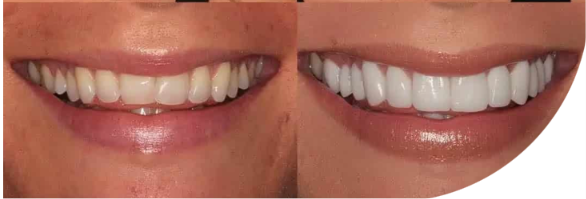
Smile Architecture evaluates facial symmetry, lip shape, and skin tone before a single tooth is touched.
Before we even discuss materials, we evaluate your facial symmetry, the shape of your lips at rest and when smiling, and your interpupillary line, the invisible horizontal line connecting your eyes, to make sure your new teeth sit perfectly level. Shade matching is just as critical: a brilliant white that looks stunning against a deep olive complexion can look jarring on someone with very fair skin, and a tooth shade brighter than the whites of your own eyes will read as artificial to anyone you speak to. Whether you choose porcelain or composite, this is the layer of planning that decides whether your new smile looks like you, only more confident, or like you are wearing someone else’s teeth.
The Clinical Journey at Salman Bin Abdulaziz – King Salman Bin Abdulaziz Al Saud St – Marsa Dubai – Dubai Marina – Dubai – United Arab Emirates
Understanding what to expect is one of the best ways to ease dental anxiety, so here is exactly what happens when you choose either treatment with us.
- Discovery Consultation. A relaxed conversation about your dental history, goals, and concerns, alongside detailed photographs and digital scans.
- Digital Smile Design. We map your new smile on screen so you can see a simulation before we touch a single tooth.
- Trial Smile and Preparation (porcelain only). We follow a strict minimal-prep philosophy, removing only what is absolutely necessary, then fit temporary veneers modeled on your digital design so you can live with the shape before the final ceramic is made.
- Final Cementation (porcelain) or Same-Day Sculpting (composite). Your finished veneers are checked for bite, color, and fit under magnification before being permanently bonded.
Protecting Your Investment: Care for Both Materials
A common misconception is that veneers, once placed, need no maintenance. In reality, protecting either material is a partnership between clinical work and daily habits.
The demanding pace of life in Dubai often contributes to bruxism, the subconscious grinding and clenching of teeth during sleep. The forces this generates can fracture composite and porcelain alike, which is why a custom-fitted night guard is one of the most important things you can do for either material.
Beyond that: brush twice daily with a non-abrasive toothpaste (whitening toothpastes contain scrubbing agents that can scratch veneer surfaces), and floss consistently. While a veneer itself cannot develop a cavity, the natural tooth structure underneath remains vulnerable to decay, and healthy gums are essential to keeping the veneer’s margin looking seamless.
Frequently Asked Questions
Do you have to shave my teeth down to little pegs? No. The horror stories you may have seen online involve aggressive crowns, not true veneers. An ethical veneer requires only a fraction of a millimeter of preparation, sometimes none at all for composite.
Does the procedure hurt? We use effective local anesthesia and a gentle touch throughout. Most patients relax with noise-cancelling headphones or a ceiling television and feel comfortable the entire time.
Can I still drink coffee with veneers? With porcelain, yes, completely safely; the material will not stain. With composite, you can still enjoy your coffee, but be mindful that staining builds gradually over time and is part of normal wear for that material.
Are veneers bad for my natural teeth? When placed correctly by an experienced, conservative dentist, no. The key is choosing a clinician who prioritizes enamel preservation over speed.
Can I switch from composite to porcelain later? Yes. Many patients start with composite to trial a new shape, then transition to porcelain once they are confident in the design.
Porcelain or Composite? Here Is How to Decide
If you want a fast, conservative, budget-friendly way to fix minor chips, gaps, or discoloration, composite is a genuinely good choice. If you are planning a full smile makeover and want the closest possible match to natural enamel with minimal long-term maintenance, porcelain is the gold standard.
But the honest truth, after twenty years of doing this, is that the material is just a tool. The real variable that determines whether you love your results is the clinician guiding the process: someone who listens to your concerns, respects your natural tooth structure, and has the trained eye to design a smile that looks like it has always belonged on your face.
If you are ready to stop covering your smile in photos and start exploring your options in a relaxed, pressure-free environment, book a consultation with Dr. Zeinab Taie at our Salman Bin Abdulaziz – King Salman Bin Abdulaziz Al Saud St – Marsa Dubai – Dubai Marina – Dubai – United Arab Emirates, clinic. We are here to answer every question, honestly.
Curious to see what either material looks like in practice? Compare real patient results in our Porcelain Dental Veneers and Resin Dental Veneers galleries, or read more about the full Smile Makeover process.